



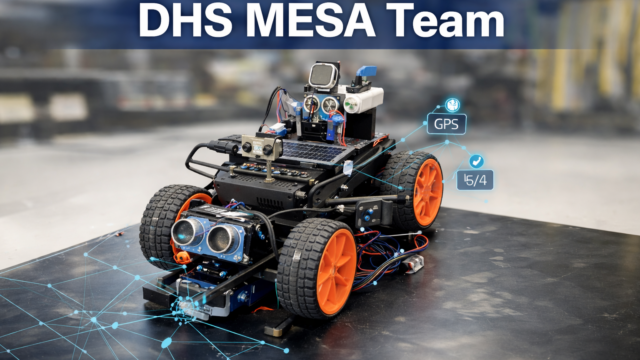
DEMING – Students from the Deming High School MESA Team have developed a working prototype of an innovative new device designed to help protect the community during dangerous weather and environmental emergencies. The project, known as the Dust Sentinel Rover, is a real, fully built robotic vehicle created by students to monitor hazardous conditions and improve safety during events such as dust storms, floods, wildfires, and windstorms.
The display for the project shows that this is not just a concept or drawing. The Dust Sentinel Rover already exists as a physical, functioning prototype, complete with wheels, onboard electronics, sensors, GPS equipment, and a hybrid power system. Photos on the project board show the rover operating as a real device, demonstrating the students’ ability to move from design to construction and testing.
Deming High School’s MESA Team developed the rover in response to the environmental challenges faced in southern New Mexico, where dust storms, poor air quality, and extreme weather can disrupt schools, travel, and public safety. The students designed the rover to serve as a mobile monitoring platform that can be sent into areas that may be unsafe for people, allowing operators to collect real-time data from a safe distance.
The Dust Sentinel Rover is equipped with sensors that measure temperature, humidity, light levels, air quality, and physical obstacles, along with a GPS module that tracks its location. It also features a hybrid power system that combines rechargeable batteries with solar panels, allowing the rover to operate for extended periods in the field without needing frequent recharging. The system can be controlled remotely through a wireless interface, enabling it to navigate through hazardous environments.
Beyond dust storms, the rover is designed as a multi-purpose emergency tool. According to the project description, it can be used during floods, wildfires, and windstorms to collect environmental data, assess risks, and support emergency response. It can also assist in post-disaster recovery by transmitting data and providing surveillance in affected areas, helping improve early warning and response coordination for schools and nearby communities.
The MESA Team describes the Dust Sentinel Rover as a low-cost, adaptable, and scalable solution that could be used not only in Deming, but also in other regions facing similar environmental hazards. The project highlights how students are using science, technology, engineering, and mathematics to solve real-world problems that directly affect their community.
Guiding and supporting the team are MESA advisors Dr. John Valdes and Dr. Rey Belen, who have helped students turn their ideas into a working, real-world prototype. Their mentorship is a key part of the program, helping students apply classroom learning to hands-on innovation.
The Dust Sentinel Rover project demonstrates the power of STEM education in action, showing how local students can combine creativity, technical skill, and community awareness to build tools that promote safety and resilience.