



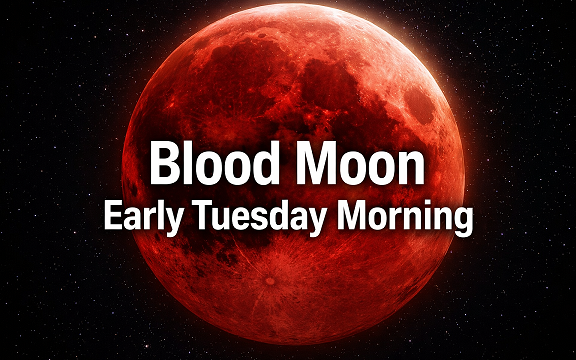
DEMING – Skywatchers across Luna County and southern New Mexico will have the opportunity to witness a striking celestial event early Tuesday morning as a total lunar eclipse transforms the Moon into a deep crimson “Blood Moon.”
A total lunar eclipse occurs when the Earth moves directly between the Sun and the Moon, casting its shadow across the lunar surface. During totality, the Moon does not disappear completely. Instead, it turns shades of copper, rust, or deep red. This dramatic color shift is what gives the event its popular name — a “Blood Moon.”
The red glow is caused by Earth’s atmosphere. As sunlight passes through our atmosphere, shorter blue wavelengths scatter, while longer red and orange wavelengths bend and filter through. That filtered light is projected onto the Moon’s surface, producing the eerie red appearance. In essence, every sunrise and sunset happening around the globe at that moment is being refracted onto the Moon.
Unlike a solar eclipse, a lunar eclipse is completely safe to view with the naked eye. No protective eyewear is required. Binoculars or a telescope can enhance the experience, revealing more detail in the Moon’s surface during totality.
For viewers in Deming and throughout the Mountain Time Zone, peak totality is expected between approximately 4:04 a.m. and 5:02 a.m. Tuesday. Conditions will be darkest before dawn, making this window ideal for viewing. Those planning to watch should find a location with a clear western horizon and minimal light pollution.
Total lunar eclipses are relatively infrequent at any one location. While they occur somewhere on Earth every couple of years, favorable viewing conditions for a specific region do not happen annually.
Astronomy experts recommend setting an early alarm, allowing your eyes to adjust to the darkness, and bringing a jacket as pre-dawn temperatures may be cool. Photographers are encouraged to use tripods and longer exposures to capture the Moon’s changing color.
If skies cooperate, this early morning event promises to be one of the most visually striking astronomical displays of the year.